Celebrate Human Rights

Celebrate Human Rights

On December 10, we’re proud to celebrate the International Human Rights Day. This year, we are joining global efforts to recognize the leadership and action of young people in their struggles for protection of dignity, and promoting equitable representation, equal rights and justice.

At UBC, we are dedicated to creating a respectful learning and working environment free of discrimination for students, staff and faculty. As an institution, we centre relationships marked by respect and dignity, and where everyone has equitable access to study and work opportunities.

Students at UBC are leading the change and sharing their voices to build an equitable and sustainable future. Learn how they are standing up for human rights and making positive change at UBC.

What can you do to stand up for human rights?

Familiarize Yourself with BC’s Human Rights Grounds

Did you know there are 14 grounds protected by the BC Human Rights Code? That means everyone has the right to be free of discrimination based on:

  • age (actual or perceived)
  • ancestry
  • colour
  • family status
  • marital status
  • physical or mental disability
  • place of origin
  • political belief
  • race
  • religion
  • sex
  • sexual orientation
  • gender identity or expression
  • criminal conviction unrelated to employment

UBC Policy #SC7 on Discrimination highlight’s UBC’s commitment to creating a study and work environment that is free from discrimination on those grounds protected by the BC Human Rights Code. The Policy calls attention to the rights and obligations of all UBC members to foster this commitment. It also provides procedures for making complaints, responding to complaints (up to and including formal investigation), and remedies to address instances of discrimination.

Organize Human Rights Training and Advising

Interested in learning how to create a discrimination free and inclusive working environment? Invite our Human Rights staff for a training session with your unit.

Support Friends and Colleagues

Hear something? See something? Say something! Ignoring discrimination and harassment will not make it go away. Listen and support people if you see discrimination happening or if they ask you for help. Speak to a staff or faculty member you know and trust, and reach out to the Equity & Inclusion Office for resources and support.

Speak to UBC’s Human Rights Advisor

The Human Rights Advisor at the Equity & Inclusion Office provides confidential information, advice and support in a fair and impartial manner. Our staff in the Human Rights portfolio can also assist in informally resolving issues of discrimination and harassment.

If you are concerned about discrimination, book an appointment to discuss your concerns with our Human Rights Advisor by emailing humanrights.advisor@equity.ubc.ca.

Want to learn more about human rights advising? Check out our profile on Roshni Narain and how her role supports human rights at UBC.
Resources and opportunities to help build a more inclusive UBC

Equity & Inclusion Office offers a number of resources and services to help you build more inclusive teams and spaces.

Consultation Services

Conflict Management and Human Rights Advising

  • If you or your team could benefit from support managing conflict in the work environment, particularly connected with issues of difference and identity, please contact the EIO’s Director of Dialogue & Conflict Engagement at conflict.advisor@equity.ubc.ca.
  • If you or your team members are experiencing issues that are related to breaches on any of the human rights grounds (breach to Policy SC7), you can get in touch with the Director of Human Rights at humanrights.advisor@equity.ubc.ca. They can provide a confidential consultation and advising to resolve issues of discrimination and harassment.

Educational Workshops

  • A new monthly workshops series, Through the Lens, aims to equip faculty and staff with a better understanding of the experiences of minoritized identity groups at the university, and with practical skills for allyship. Sessions are running until May at the Vancouver campus and parallel sessions will take place on the Okanagan campus once per semester. Please help ensure your teams are aware of upcoming sessions, listed here: https://equity.ubc.ca/through-the-lens/

Trans, Two-Spirit and Gender Diversity Taskforce

  • In the new year, we will be convening a Trans, Two-Spirit and Gender Diversity Taskforce that will provide strategic direction to UBC’s senior leadership in the area of gender identity/expression and human rights. The task force is being formed in response to emerging campus and community needs and the addition of gender identity and gender expression to the BC Human Rights Code. A call for applications from those interested in being part of the taskforce will be issued in January.

Inclusive Holidays Resources

Thank you for your continued support in helping to create a respectful and inclusive environment, where diverse ideas and perspectives can thrive.

BIPOC Connections: Staff and Faculty Lunch

Looking to join and build a community for BIPOC staff and faculty? Join us for the inaugural BIPOC Connections lunch – a social gathering for faculty and staff who self-identify as Black, Indigenous or as a Person of Colour (BIPOC).

Call for Applications: Equity Student Advisory Council

Recap: In Conversation with David Chariandy

By Gabrielle Bonifacio, Communications Assistant (Work-Learn), UBC Equity & Inclusion Office

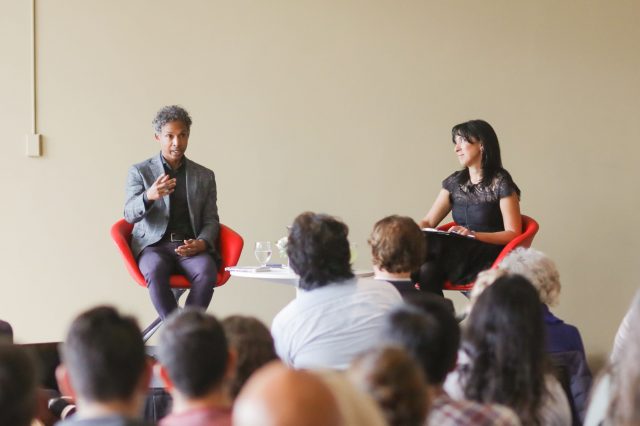
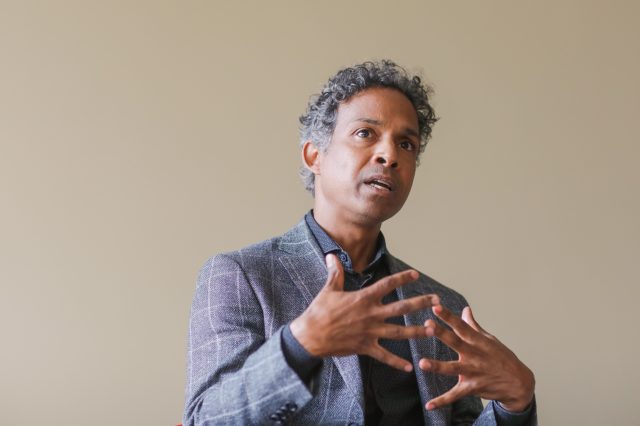
It was a full house at Sage Bistro on October 3rd, with 150 attendees chatting over coffee, tea and cookies as they eagerly awaited the arrival of celebrated author and professor, Dr. David Chariandy.

Dr. Chariandy was the first author featured by the IGNITE Book Club, an ongoing series hosted by Dr. Minelle Mahtani, a former journalist at the CBC and current Senior Advisor to the Provost on Racialized Faculty. Created by and for racialized faculty, Ignite Book Club couldn’t have picked a better inaugural speaker than Chariandy. He came prepared to discuss everything from his latest release, I’ve Been Meaning to Tell You: A Letter To My Daughter to personal anecdotes about his family and life as a devoted parent.

Guests listened with focus as Chariandy responded to Mahtani’s thoughtful inquiries with stories that ranged from joyful to frustrating. Ultimately, his words touched on experiences that seemed painfully familiar for many in the room; daily micro aggressions, blatant slurs from peers, the complexities that come with “inherited trauma” and so on. He spoke gracefully about being confronted by his racial identity even in the places one would least expect: waiting in line at a water fountain after a pleasant afternoon with his then four-year-old daughter.

The room was filled with nods and audible hums of agreement after such stories. To use Chariandy’s words, it was a powerful way of saying: I feel you. After all, to see your experiences represented is no small gesture, particularly for racialized people who have often been erased, misrepresented and neglected by the media. For Chariandy, it was a self-proclaimed “revelation” that resulted in him physically “sinking” into Carleton University’s library carpet.

During his second year of university, Chariandy got his hands on James Baldwin’s The Price of the Ticket. Prior to this, he had never encountered a collection written by a writer of colour. Years after the fact, he would attribute his reaction to a profound feeling of “connection”, an epiphany that manifested in Baldwin’s words which he recalled, verbatim: The world is white no longer, and it will never be white again.  

Connection was one of the driving forces behind his most recent memoir, I’ve Been Meaning to Tell You: A Letter To My Daughter. This, combined with the sobering realization he felt when his daughter was born. Chariandy spoke honestly of the fear that came with the knowledge that he could not protect his daughter from racism any more than his immigrant parents could for him, or he for them. All he could do was “simply tell [his] own story” in the hopes of forging the kind of connection that he had found as a student.

Despite the heavy subject matter, there were moments of levity and laughter—Chariandy’s shout out to Beyoncé comes to mind—steered by the ease and expertise of Mahtani’s moderation.  After an hour of thorough discussion, the evening closed with Chariandy reading a passage detailing a moment between himself and his daughter.

Perhaps it is not so terrible, then, if as Chariandy suggests, “telling stories is all we can do”. Because it is through these stories that we learn to see and think differently, about the world, our neighbours and ourselves.

See more photos from the event.

Inclusive Costumes

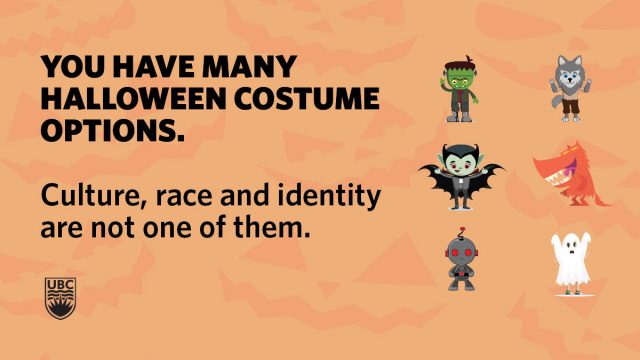
With Halloween fast approaching, costume selection is top of mind for many. Yet, while costume options may be limitless, someone’s culture, race, or identity is not a costume.

When your costume trivializes someone’s culture, race, or identity, it reduces these aspects to stereotypes – so be creative and respectful with your costumes!

Take a moment to ask yourself:

  • Is my costume making fun of human traits, identities, cultures, or race?
  • Does my costume represent a culture that is not my own?
  • Does my costume reduce cultural or identity differences to stereotypes?
  • Would you be ashamed if your family or future employer saw your costume?

Still unsure or looking for other options? Check out some of these creative costume ideas below!

Unicorn
They are mythical, rare, and unique – just like you. Good luck finding one – they are hard to catch…or so we hear.

Zombie
Take a cue from The Last of Us and dress up as your favorite zombie-like creature.

Pennywise the Clown
A classic look for Halloween, embrace the spooky energy by putting on a frightening red wig and inflating some red balloons.

Your favourite Halloween candy
Whether you’re a fan of creamy peanut butter cups or crispy wafer bars, show your love for Halloween by dressing up as the best part – delicious candy!

Your favourite fantasy character
Have a favourite droid or fictional monster? Or perhaps a favourite video game character? This is the perfect time to transform yourself and live in your favourite fantasy world!

Dog walker
For all you puppy lovers out there! Round up your favourite canines and be a dog walker for the day.

Pokémon trainer
Cozy up in your Gengar sweater and clip a few poke balls to your belt and you’ll be the spookiest trainer out there.

Molecule or chemical element
The look for all the scientists on campus! Embrace the day as your favourite element from the periodic table. Or perhaps stable cyclohexanes are your calling.

September 30th Is Orange Shirt Day

Pride at UBC: See what’s happening

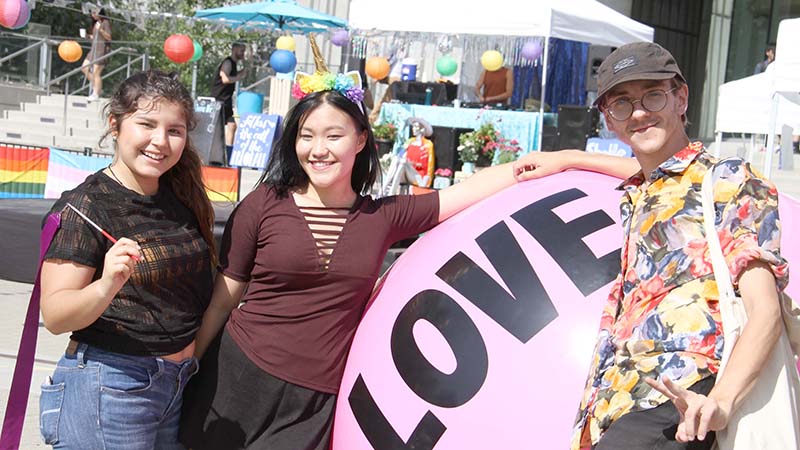
Explore the many Pride activities at UBC, connect with your community, help create positive space on and off campus and stand up for sexual orientation and gender identity (SOGI) diversity.

Ideas to action: Building a plan for a more inclusive UBC

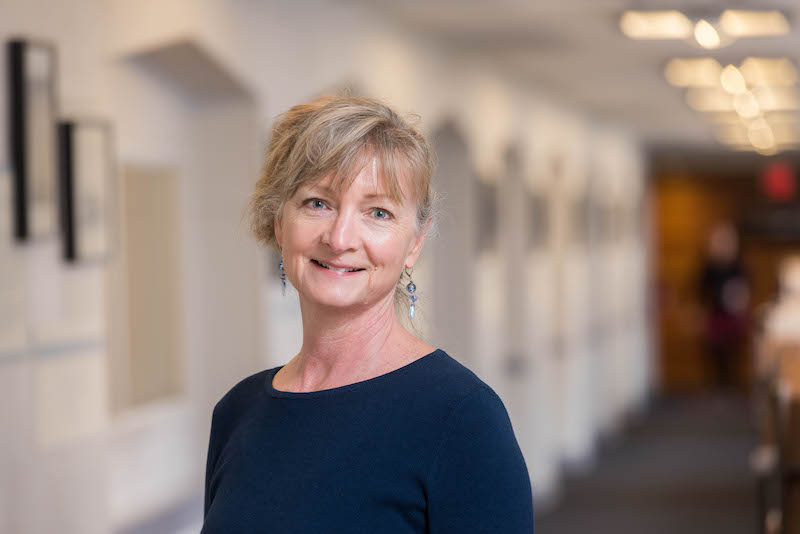
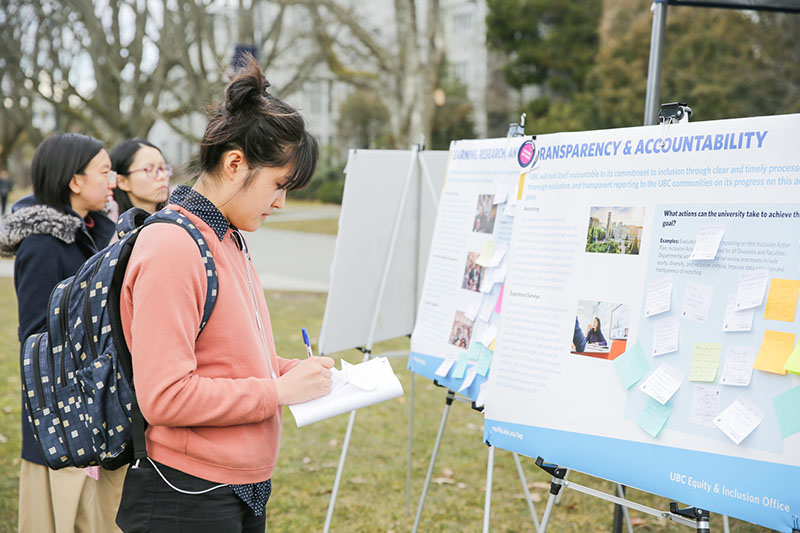
Louise Griep, Engagement Strategist with the Equity & Inclusion Office, shares her experience of facilitating the development of UBC’s Inclusion Action Plan (IAP), and how she hopes the plan will create a more inclusive and equitable environment at UBC.

University-wide engagements around the plan will continue over July, August, and September 2019. The refined draft plan will be presented to the UBC executive in October, and the Board of Governors for approval in early December.

What does the IAP mean for staff, faculty, and students?  How will this change their experience at UBC?

The IAP provides a common understanding of the directions and actions that we agreed would most likely help us create a more welcoming and inclusive university.

There are a lot of existing and inspiring efforts already under way all across campus, and the IAP provides an opportunity to leverage these efforts towards greater collective impact. Everyone on campus is and will be able to contribute towards that.

We want to build more equitable and inclusive opportunities for students, staff, faculty, as well as senior leadership. This means addressing people’s experiences, and particularly the experiences of those community members that have been historically, persistently or systemically marginalized.

The core of the plan focuses on building our capacity as community members to be more inclusive. It also aims to identify how we can transform our systems so that the university itself – as an institution – has the capacity, systems, and policies that ensure that community members have equitable opportunities to flourish – whether in learning, teaching, researching or working.

For example, I – well “we” – hope everyone can reflect on their own positions, explore what they can do to help reverse marginalization, and consider how they can engage with their peers and colleagues. It also considers how and what data is being gathered, and how that informs our decisions; how research might be done with and across diverse groups to influence innovation and drive change in the system; and how we can attract and retain an excellent and diverse workforce and academic community.

Overall, the plan is intended to build a more inclusive UBC – as an institution and as a community.

How would you define inclusion?

It’s beyond just fairness and equity around how people are recruited, treated, recognized, welcomed and included.

As we’ve suggested in the plan, it’s a commitment to creating a welcoming community where those historically, persistently or systemically marginalized are treated equitably, feel respected and belong. Inclusion is built by individual and institutional responsibility through continuous engagement with diversity to inspire people, ideas and actions for a better world.

What did you hear from the initial community engagement efforts?

This plan is really important to the UBC community! People want to be able to thrive, in all their diversity – and they care about that deeply. This plan and process will hopefully provide resources and opportunities to enable that to happen at UBC.

We heard from over 1,750 students, staff, and faculty and collected over 5,400 action ideas. Details of that will be published shortly in a “What We Heard” report so that everyone can learn about the ideas that were submitted and considered.

What surprised you the most?

One of the things that stood out was how engaged, interested and supportive the community is around this work. It was also a great opportunity to learn about all the diverse efforts already under way.

The other thing that appeared to come up frequently is accountability – this notion that folks are really eager to ensure that if we’re talking about this work, we have to actually do it, live it and be transparent about progress.

Can you tell us a little bit about next steps and how the IAP might impact change?

We will shortly be sharing information and invitations to in-depth consultations with those who will be most directly affected by the plan – those who have been historically, persistently, and systemically marginalized, as well as with various leadership groups that will be supporting the implementation of the plan.

The refined draft plan will be presented to the UBC executives in October, and the Board of Governors for approval in early December. After the plan is approved, we will develop implementation approaches and resources to guide units in their own efforts around inclusion.

I hope that people across the university feel like change can happen – will happen – and that they can see it happening. And if it doesn’t, that they have opportunities and ways to share their perspectives, and that appropriate mechanisms are in place to keep us on track.

How can the campus community stay involved?

Participate in our engagement sessions in August and September, and if you can’t, read the draft IAP on our website and leave a comment. You can also sign-up for our newsletter and learn about upcoming announcements, events and involvement opportunities, education and resources.

To learn more about the IAP, visit equity.ubc.ca/iap.

Show Your Support as an Ally

If you don’t identify as a member of the LGBTQ2SIA+ community, here’s what you can do to educate yourself, be an ally and help build a more inclusive UBC.

What can you do?

Respect people’s identity
Be mindful of people’s comfort with how public they are with their identity, and how it can affect their safety. Don’t out someone’s sexual orientation and/or gender identity.

You know what they say about assuming…
Never assume someone’s sexual orientation and/or gender identity. Respectfully ask people what pronouns they use regardless of their name or appearance.

Use gender inclusive language
Use language like “everyone” and “folks” rather than “guys” or “ladies.”

Speak up!
Let people know when you find transphobic and homophobic comments and jokes hurtful and offensive.

Educate yourself
Seek out resources and learn about issues that impact LGBTQ2SIA+ communities.

Use the correct pronouns

People do not always use pronouns that you may expect. It’s important to use someone’s correct pronoun to support their well-being and to validate their identity.

The following table shows a few examples of personal pronouns and how to use them:

 Nominative (subject)Objective (object)Possessive determinerPossessive PronounReflexive
SheShe laughedI called herHer eyes gleamThat is hersShe likes herself
HeHe laughedI called himHis eyes gleamThat is hisHe likes himself
TheyThey laughedI called themTheir eyes gleamThat is theirsThey like themselves
ZeZe laughedI called hir/zirHir/Zir eyes gleamThat is hirs/zirsZe likes hirself/zirself

These are just a few examples. Usage varies over time and based on location, so expect to encounter other pronouns you may not be familiar with.

Please note: Some people may just want you to use their name and avoid pronouns altogether.

Learn the language

Lesbian, gay, bisexual, trans (transgender, gender non-conforming and non-binary), two-spirit, queer, questioning, intersex and asexual.

Allies take action and work towards recognizing their own biases and privileges, offer support and celebrate all sexual orientations and gender identities.