Have Your Say: UBC Pride Installation
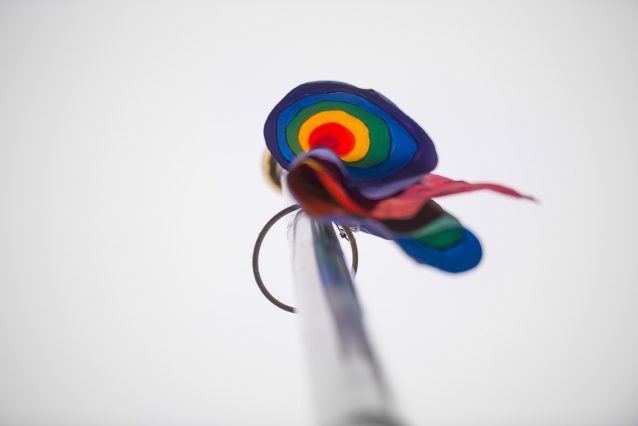
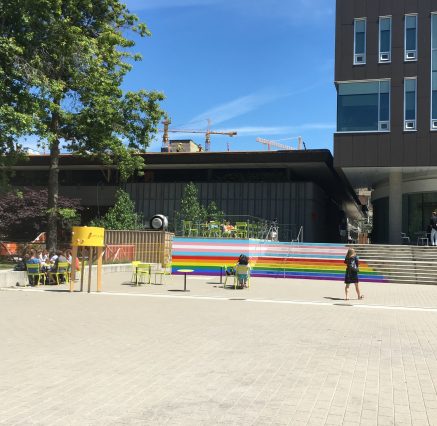
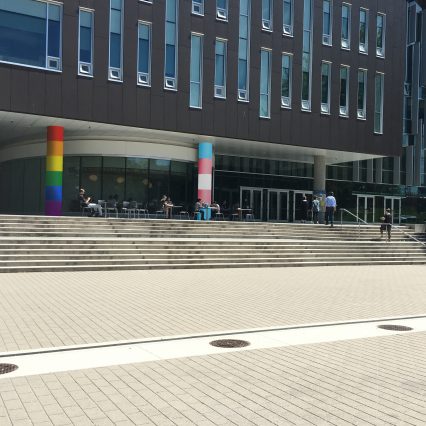
To build a more welcoming and inclusive UBC, the Equity & Inclusion Office is working with campus partners to bring a Pride installation to the AMS Nest. Funding for this project is provided by the graduating class of 2018 as a gift to the university community.
The installation reflects UBC’s commitments to build a more welcoming and inclusive campus community.
In collaboration with our key partners, we developed three design options and are inviting public feedback to help inform the project’s advisory committee decision.
Take a moment to tell us which of the options is your favourite and help shape of our campus community.
Project Update
Based on community feedback, Option 2 was identified as a preferred choice for location and design concept. In addition to the location preference, community expressed interest in the addition of black and brown stripes to the Pride flag.
Acting on this feedback, we’ve modified the design to add the black and brown stripes as a way to recognize the role, diversity, intersectionality, and inclusion of historically marginalized community members within, and beyond, the LGBT2SQIA+ community.
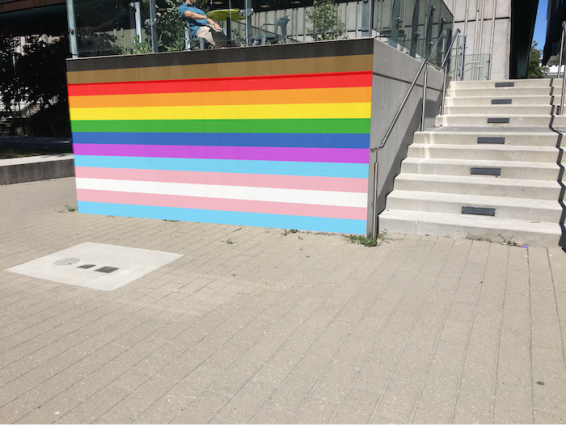
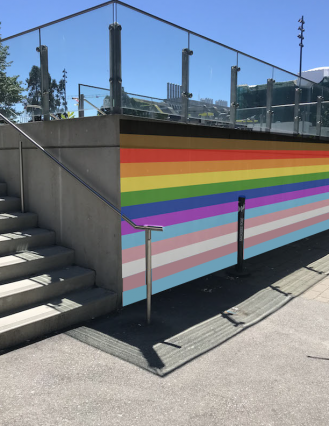
Do you have additional feedback on how inclusive this design iteration is? Let us know by Wednesday, August 8th, via the comment box below.
Initial Design Options
Click on each option to view the proposed design.
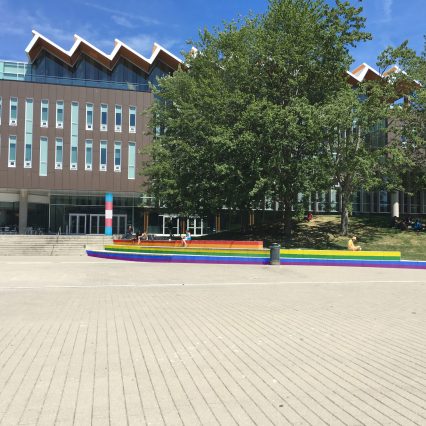
Which One Is Your Favourite?
Thanks to everyone who participated in this poll. We look forward to unveiling the design.
Project Overview
The proposed installation will be a permanent symbol of the University’s commitment to creating a more welcoming and inclusive UBC.
Key partners that informed the development of design options include the UBC Alma Mater Society, the UBC Pride Collective, and Campus + Community Planning, with members from the Musqueam First Nation, the First Nations House of Learning, and the project advisory committee providing additional feedback.
The installation makes visible our commitment to building respectful, supportive, educational and inclusive spaces for lesbian, gay, bisexual, queer, two spirited, intersex, asexual and trans people, as well as those questioning their sexual orientation and/or gender identity. It will recognize and celebrate the vast range of gender and sexual identities that are represented within our community.
Project Goals
- To foster inclusivity – welcome everyone (LGBTQ2+ and allies) by bringing pride and trans colours to help signal UBC’s public spaces as positive spaces;
- To challenge patterns of silence around LGBTQ2+ issues and persons to help create a more visibly welcoming, safer and non-exclusionary campus community for all;
- To affirm and show UBC’s belief that our community is enriched and enlivened by the diversity of its community, including LGBTQ2+ persons;
- To build a sense of belonging and shared purpose in UBC’s public realm;
- To empower people with diverse sexual orientations, gender identities and gender expressions;
- To inspire our community through art and ideas while creating transformational experiences in the new proposed space.
FAQ
We’ve selected high-quality, durable paint materials so that the installation can withstand weather elements over time. We’ve also allocated a budget for ongoing maintenance and repair through the duration of this installation.
While consideration was given to other locations on campus, this space was selected for a number of reasons, including feasibility, centrality, exposure on campus, and the connection to UBC's hub for students, the AMS Nest, and the 2018 graduating class.
Funding for this project is provided by the graduating class of 2018 as a gift to the university community.
Timelines
Selection
Initial survey closed on June 24th. Following the survey, the advisory committee met to review the results and decide on the design. A second design version was developed and is presented above for feedback.
Implementation
Based on community feedback, we are exploring additional design considerations as per Project Update above.
Reveal
We are aiming to reveal this project in early September. More information about the reveal and any associated events will be posted here.
Advisory Committee
- Alma Mater Society (AMS)
- UBC Pride Collective
- Totem Park Pride Collective
- Queers and Gears
- UBC Bike Co-op
- Faculty from the Institute of Gender, Race, Sexuality and Social Justice
- alumni UBC
- Equity & Inclusion Office
- Campus + Community Planning
Q&A: Working to Build a More a Accessible Campus Community
As part of recognizing those who are working to remove barriers to participation, we connected with Earllene Roberts, manager of the Disability Resource Centre at UBC Okanagan. She shares with us her perspectives on building a more accessible and inclusive UBC.
Why do you think it is important to mark the National AccessAbility Week?
Now in its second year, the National AccessAbility Week is an opportunity to celebrate contributions of persons with disabilities, and consider ways that we can continue removing barriers to participation so that we build a more inclusive UBC. It’s an opportunity to think about what more we can do to promote the rights and well-being of persons with disabilities in all spheres of society and development, and to increase awareness of the situation of persons with disabilities in every aspect of political, social, economic and cultural life.
This week serves as a continued reminder of the situation that persons with disabilities still face. The mainstream discourse does yet not fully value the many contributions of disabled people and communities. For me, this week is about recognizing how our daily practices matter in terms of whether individuals, all individuals, feel included or not.
It’s really important to recognize this week. Not just one week per year. It’s about recognizing how our daily practices may be contributing to continued propagations of stereotypes and discrimination, and about reflecting on how we can all play a part in changing that.
How have things changed in recent years? What do you think would contribute to a more positive environment for people with disabilities in the workplace?
Things have certainly changed, but in the post-secondary context, people with disabilities are still significantly under represented.
In the post-secondary context, people with disabilities are significantly under represented. 27 per cent of Canadians have post-secondary degrees, as opposed to 14 per cent of disabled Canadians. As a result, these individuals often experience increased rates of poverty, lower involvement in the labour market, higher under employment and unemployment.
At the institutional level, we are working to create inclusive places for all people on campus, taking action to ensure adequate policies are in place, and making efforts to remove barriers that enable discrimination and prevent inclusion.
In order to contribute to a more positive environment, we need to look at everything that we do and take into consideration how discrimination operates – and voices of persons with disabilities are essential to these conversations. We’ve done that with other groups on other issues, so it is definitely possible.
Lastly, we also need to move beyond awareness alone and our legal duty to accommodate. While progress to date has been made largely through legal mechanism, we need to focus on reinforcing an inclusive culture where disabled people are seen as valuable members of society. Through these efforts, we want to see our disabled community members achieve same successes as non disabled people (able-bodied person).
How can students, staff and faculty members get involved in supporting a better environment for all people with disabilities on campus?
A lot of research has been done around what factors either advance or act as a barrier to inclusion. The recommendations that come out of the literature tend to focus on awareness of issues, training for faculty, and implemention of specific policies – those are all great – however, we need to continue to shift the culture at universities away from primarily ableism.
For example, our students can make a big difference to our culture by doing something as seemingly simple as how they value group work participation, how they understand how different people may approach or process the work, or do the work, and how they perceive the value of those contributions. Through these efforts with our students, staff and faculty, we are continuing to foster an environment where individual differences are valued for the benefits they can bring.
Lastly, I urge staff and faculty to reflect on how they think and talk about disability and their day-to-day actions. People don’t always recognize that they’re being ableist or discriminatory. We’re seeing progress, however, there’s still work to do so that we all are comfortable with recognizing how our actions can contribute to a discriminatory culture.
Additional Resources
Community Projects Awarded Funding to Build a More Inclusive UBC
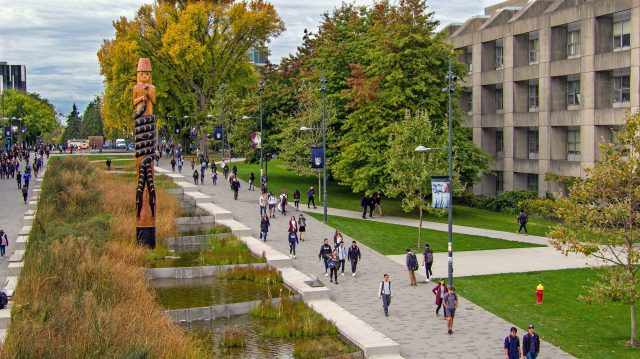
18 student, faculty and staff projects are awarded funding from the UBC Equity Enhancement Fund. Projects will engage the campus community in building a more welcoming and inclusive UBC.
As part of the annual Equity Enhancement Fund call for applications, the Equity & Inclusion Office received 37 submissions for a total of $406,000 in requested funding. With $90,000 in the Equity Enhancement Fund available for disbursement, an internal adjudication panel evaluated applications and selected 14 projects at UBC Vancouver and four at UBC Okanagan to receive funding.
This year’s projects focus on diverse areas of equity and inclusion work, including race and culture, sexual orientation and gender identity, gender equity, and Indigeneity. A number of projects also seek to inform broader campus experiences across teaching, learning and research, and community engagement.
Associate Vice-President Sara-Jane Finlay praised the quality and variety of this year’s projects.
“It was wonderful to see all the creative ideas in the applications received – however, that also made it more difficult to make the final selection. The selected projects focus on bringing benefits to the representation or experiences of those people who have been historically marginalized, and seek to build the competencies of our students, staff and faculty to engage with diversity.”
The Equity Enhancement Fund is open to students, staff and faculty as a way to support collaborative community-led initiatives that engage the community and help advance equity and inclusion at UBC.
Each year, a total of $90,000 is available for disbursement across UBC Vancouver ($75,000) and UBC Okanagan ($15,000) campuses. Individual projects can receive up to $25,000 at UBC Vancouver, and up to $10,000 at UBC Okanagan.
Call for applications opens in January each year and is widely broadcast across the university. The Equity & Inclusion Office hosts workshops and events to showcase past projects and support those interested in applying.
Inclusion is one of the key priority areas in UBC’s new strategic plan, Inspire, and these projects will now play an important role in helping to build a more inclusive UBC.
Reflections from Past Participants
“The Equity Enhancement Fund we secured two years ago catalyzed an extremely effective project, Teacher Education For All. It has grown into a Faculty-wide initiative highlighting SOGI-inclusive culture and practices.”
- Wendy Carr, Associate Dean, Teacher Education Faculty of Education
“The Equity Enhancement Fund has been critical to the success of the Wingspan Disability Arts, Culture and Public Pedagogy’s cluster success, drawing attention to the neglected turn of disability in social justice work at UBC and beyond.”
- Professor Leslie Roman, Co-Chair, President’s Working Committee on Disability Culture, Art and Equity
“The Equity Enhancement Fund not only provided us funds to do great things, but helped spark a more strategic conversation about what our unit needs and gave us latitude to experiment.”
- Sarah E Gergel, Associate Dean, Diversity & Inclusion Faculty of Forestry
Funded Projects
UBC Vancouver
The F-Word Conference is a student-run initiative providing a platform for community-based collaborative work on social injustice. This year, the project seeks to facilitate discussion surrounding issues of climate change, food sustainability, Indigenous land rights, race and space, ableism, gentrification, queer studies, and reproductive rights. The F-Word conference is attended by students, faculty, and members from the UBC community and is deeply involved with issues present on our campus. Our theme directly relates to environmental justice and sustainability by bringing into question the current state of our environment, and how it disproportionately affects marginalized groups. This year, our keynote speaker is Ta’Kaiya Blaney, a young Indigenous activist for environmental rights. Our six workshops are centered around topics relating to climate justice, food (in)security, refugees, sexual assault, divestment from fossil fuels, residential schools.
Primary contacts: Gender, Race, Sexuality, and Social Justice Undergraduate Association
Additional contacts and/or parties involved: UBC Arts Undergraduate Society, UBC Sexual Assault Support Centre, UBCC350
This project will facilitate a community consultation between academic philosophers based in the Vancouver area and members of the local Indigenous communities about the prospects for a dialogue between Indigenous and academic philosophy. Academic philosophy in Canada has been slow to include Indigenous philosophies within the mainstream curriculum, at least partly because of sensitivity to concerns about cultural appropriation. This student-initiated proposal for a collaborative dialogue on how to move forward would assist academic philosophers interested in including Indigenous curriculum in existing courses, and will help address barriers to greater participation of Indigenous students in mainstream academic philosophy as a discipline. It will enhance diversity in UBC philosophy classrooms, and explore models for an equitable and collaborative dialogue between academics and community members.
Primary contacts: Prof. Sylvia Berryman, Department of Philosophy, Faculty of Arts
Additional contacts and/or parties involved: Kwantlen Polytechnical University Aboriginal Club, Department of Philosophy, Simon Fraser University
This project creatively theorizes and critically explores blackness as it relates to the settler land of Canada. How do we consider multiple sites of oppression, both as oppressors (as settlers) and subjects of oppression (as minorities)? How do we situate these questions locally and nationally, whilst building and sustaining relationships between the people that these matters affect? By creating a film and holding public panels, the project aims to foster supportive reflections and contribute to the project of modifying what constitutes the archive. Importantly, focusing on diversity within communities of colour and promoting POC-led initiatives will help to dismantle the framework of White vs. Other. What we intend is to promote conversations about how all communities can live with one another in a meaningful way.
Primary contacts: Emmanuelle Andrews and Pedro Daher, Institute for Gender, Race, Sexuality and Social Justice
Additional contacts and/or parties involved: Institute for Gender, Race, Sexuality and Social Justice
Creation of an online, self-paced module that equips Search and Selection Committees with a baseline knowledge of equity and diversity best practices for the hiring of faculty and leadership roles (deans, vice-deans, assistant deans, associate deans, executives, department heads). The proposed online module will replace a portion of, and act as a supplement to current practices. An online module of this nature enhances the equity, diversity and inclusion of UBC by guiding the selection process for faculty and leadership roles to be more equitable and inclusive, through the identification of qualified and outstanding candidates who may otherwise be overlooked due to the unconscious biases held by members of Search and Selection Committees. The online module will be first piloted in the Faculty of Medicine with the view that this would be available –at no cost- to all faculties and academic units.
Primary contacts: Dr. Gurdeep Parhar, Executive Associate Dean, Clinical Partnerships and Professionalism, Faculty of Medicine
Additional contacts and/or parties involved: Senior Advisor to the Provost on Women Faculty; Faculty of Medicine
UBC can act as a role model for promoting equity and inclusion in recreation, and by doing so can reach an organizational goal of improving health and enhancing overall campus experience. This project proposal is grounded in a vision to integrate research with practice, leverage internal and external partner expertise, and set the foundation to address gaps in recreation service provision to better meet the needs of underrepresented groups.
Specifically, this project involves:
- Research (existing and new): Gather info on participation, barriers to access & facilitating factors, and considerations around culture, perceptions, concerns, beliefs.
- Partnerships: Work cross-campus to understand needs, gaps, and leverage human expertise.
- Capacity building: Develop & deliver staff training, create targeted education campaign, change A&R messaging, target programming.
- Inform department plans: Review, adapt and develop recreation programs, marketing and messages.
Primary contacts: Lizzy Gun, Manager, Physical Activity, UBC Athletics and Recreation
Additional contacts and/or parties involved: School of Kinesiology; Office of the Vice-President, Students
UBC can act as a role model for promoting equity and inclusion in recreation, and by doing so can reach an organizational goal of improving health and enhancing overall campus experience. This project proposal is grounded in a vision to integrate research with practice, leverage internal and external partner expertise, and set the foundation to address gaps in recreation service provision to better meet the needs of underrepresented groups.
Specifically, this project involves:
- Research (existing and new): Gather info on participation, barriers to access & facilitating factors, and considerations around culture, perceptions, concerns, beliefs.
- Partnerships: Work cross-campus to understand needs, gaps, and leverage human expertise.
- Capacity building: Develop & deliver staff training, create targeted education campaign, change A&R messaging, target programming.
- Inform department plans: Review, adapt and develop recreation programs, marketing and messages.
Primary contacts: Chris Lee, Associate Professor, Department of English, and Director, Asian Canadian and Asian Migration Studies (ACAM)
Additional contacts and/or parties involved: St. John's College
Community Development, the Centre for Community Engaged Learning and the Arts and Culture District are proposing to launch a bold, new festival-like conference at UBC for International Women’s Day 2019. This project aims to engage our community of students, faculty, staff the general public in an important dialogue about issues central to the lives of women, trans women, non-binary people and those who face inequalities based on sex and gender identity through discussions, workshops, art and performances that inspire and allow our community to creatively co-create change together. This will not be an ordinary conference; in fact we aim to we aim to strike new partnerships across our campus to provide an event with programming, lessons and celebrations that are as diverse as women themselves.
Primary contacts: Shiloh Bouvette, Manager, Community Programs, Campus + Community Planning
Additional contacts and/or parties involved: Arts and Culture District; UBC Centre for Community Engaged Learning (CCEL)
Multiprofessional and interprofessional opportunities for students to learn from people with visible and non-visible disabilities are offered by Patient & Community Partnership for Education, Office of UBC Health. Our goal is to extend opportunities for all students in health professional programs to learn directly from people living with a disability by producing learning resources illustrating multiple perspectives on stereotypes, barriers to access, and communication challenges. In Phase 1 we conducted needs assessments with students and people with disabilities, developed collaborations with community organizations, created a database of recommended learning resources, developed a workshop model and began to create a digital ‘human library’. In Phase 2 we will maximize use and sustainability of resources through user testing and faculty engagement linked to UBC Health Patient Engagement Framework, and create new resources on experiences of people who are deaf and hard of hearing.
Primary contact: Dr. Angela Towle, Co-Director, Patient and Community Partnership for Education, UBC Health
In Phase 3 of our successful Perspective and Strength project, the Learning Exchange (LE) will enhance our Downtown Eastside
(DTES) orientation materials to fill identified gaps. This project enhances equity by directly involving DTES residents as experts with lived experience, who put a human face to an often misunderstood and underrepresented community, to help counter stereotypes and negative perceptions through orientations. Based on the continuing interest and positive responses to the project thus far, and growing interest from community partners, we would like to create new materials that further reflect the DTES community and its residents in an inclusive, equitable and authentic way.
Primary contact: Kathleen Leahy, Director, UBC Learning Exchange
Additional contacts and/or parties involved: UBC Learning Exchange; UBC Health
In Phase 3 of our successful Perspective and Strength project, the Learning Exchange (LE) will enhance our Downtown Eastside
(DTES) orientation materials to fill identified gaps. This project enhances equity by directly involving DTES residents as experts with lived experience, who put a human face to an often misunderstood and underrepresented community, to help counter stereotypes and negative perceptions through orientations. Based on the continuing interest and positive responses to the project thus far, and growing interest from community partners, we would like to create new materials that further reflect the DTES community and its residents in an inclusive, equitable and authentic way.
Primary contact: Dr. Alison Taylor, Faculty of Education
Additional contacts and/or parties involved: UBC Learning Exchange; UBC Centre for Community-Engaged Learning (CCEL)
The Truth and Reconciliation Commission's Call to Action #92 focuses on the business sector, calling for training in intercultural competency, human rights, and anti-racism. Ch’nook at Sauder wants to take this call seriously. We propose the creation of an Indigenous Cultural Awareness and Sensitivity Training (ICAST) program that will be delivered to all new Ch’nook (largely student) employees. This will be a one week program covering topics related to the history of Indigenous peoples and colonialism in Canada, cultural sensitivity and cross-cultural dialogue, communication principles, as well as better understanding trauma. Furthermore, Ch’nook – in collaboration with the School of Law and Faculty of Forestry – will also host a book club in which participants will read works by indigenous authors and discuss the issues raised in a safe space. The workshop & book club will promote, through education and dialogue, greater competencies & understanding of the importance of equity and inclusion within the UBC community
Primary contact: Kristin Smart, Program Manager, Ch'Nook Indigenous Business Education at the Sauder School of Business
Additional contacts and/or parties involved: Heiltsuk Tribal Council; Peter A. Allard School of Law
The Truth and Reconciliation Commission's Call to Action #92 focuses on the business sector, calling for training in intercultural competency, human rights, and anti-racism. Ch’nook at Sauder wants to take this call seriously. We propose the creation of an Indigenous Cultural Awareness and Sensitivity Training (ICAST) program that will be delivered to all new Ch’nook (largely student) employees. This will be a one week program covering topics related to the history of Indigenous peoples and colonialism in Canada, cultural sensitivity and cross-cultural dialogue, communication principles, as well as better understanding trauma. Furthermore, Ch’nook – in collaboration with the School of Law and Faculty of Forestry – will also host a book club in which participants will read works by indigenous authors and discuss the issues raised in a safe space. The workshop & book club will promote, through education and dialogue, greater competencies & understanding of the importance of equity and inclusion within the UBC community.
Primary contact: Professor Daisy Rosenblum, Faculty of Arts
Additional contacts and/or parties involved: Indigenous Initiatives, Centre for Teaching and Learning Technology (CTLT)
The Africa Business Club is a student initiated club which was created in 2015. The main aim of our club is to shed light on the African continent through the process of unlearning and relearning the notion of Africa being solely a hub for humanitarian aid. In order to do so, our club focuses on business in Africa which is growing at one of the fastest rates in the world and to encourage others to invest in businesses in Africa. Each year, we organize one of the largest African centered conferences in Western Canada where delegates engage in a useful dialogue. The plan for next year’s Africa Business Forum is to expand on this success, maintaining the high quality of speakers and presenters whilst further expanding brand awareness, multi-faculty campus participation and encourage diversity in the pool of participants. The project will support UBCs equity and inclusion efforts in three ways. Firstly, it will increase the intercultural understanding of UBC students have on business business in Africa. Secondly, increase international engagement for students staff and faculty. Lastly, Increase the dialogue on the importance of Business in Africa.
Primary contact: Fatou Kine Ndiaye, Sauder School of Business
Additional contacts and/or parties involved: Faculty of Applied Science; Sauder School of Business; MasterCard Foundation
This project seeks to create and implement a series of professional learning related events and activities that help transform the teaching and learning of Indigenous knowledges, perspectives, and pedagogies within the Faculty of Education. Specifically, we will introduce faculty, staff, instructors, and teaching assistants to Indigenous understandings of health and wellbeing providing comprehensive insight into the complex social, cultural, historical, and economic factors that shape health, wellbeing and healthy living within Indigenous communities with the goal of transforming curriculum and teaching approaches. Our project builds upon the natural synergies of departments within the Faculty of Education intersecting with the diverse course offerings and differently positioned faculty.
Primary contact: Dr. Darren Warburton, School of Kinesiology, Faculty of Education
Additional contacts and/or parties involved: School of Kinesiology, Faculty of Education; Native Indigenous Teacher Education Program; Lytton First Nation; Musqueam Indian Band
The Powwow is currently in its fourth year of running, and has been a great event that has attracted 1000’s of people every year. The Powwow attracts participants in the Powwow from UBC, the local community, other parts of British Columbia, and even Washington State. Currently our budget predicts a cost of 14000 dollars in order to cover the costs of the facility rental, which this year the Alma Mater Society has donated 3500 to cover partial costs, as well as the fees of the performers and costs of the prizes that are given to the dancers and participants, and the Musqueam welcome. The Powwow is a community gathering that attracts both Indigenous people as well as non-indigenous peoples, being on the unceded territory of the Musqueam nation and where UBC is located, this allows students to experience an event like a Powwow which is something that many students here would not have experienced previously.
Primary contact: Tiffany Storry, President, Indigenous Students Association
Additional contacts and/or parties involved: First Nations Studies Students’ Association; UBC Alma Mater Society
UBC Okanagan
This project seeks to use storytelling to engage the campus community in a discussion on the validity of non-western ideas as epistemologically valid. The projects is positioned as essential to the internationalization and indigenization of the curriculum in a global society.
Primary contact: Mundia Kabunda, Student, Bachelor of Arts
Additional contacts and/or parties involved: UBC Students' Union Okanagan
UBC Creative Studies faculty work with various non-profit LGBT groups to present queer cultural events significant to that community, and which promote positive health benefits for the community. These events are: a World AIDS Day memorial event/literary reading in support of the Living Positive Resource Centre, a performance cabaret featuring student performers alongside local and lower mainland talent, run in conjunction with the Guythering, organized by the Men’s Health Initiative, an LGBT film series, and a queer comedy night fundraiser (combining grad student talent with pro comedians) to keep the series sustainable. This creative research programming designed in partnership with LPRC, the Men’s Health Initiative and UBCO Creative Studies Faculty will create new access points to LGBTQI2 resources for UBCO students and the greater Kelowna community.
Primary contact: Associate Prof Michael V. Smith, Faculty of Creative and Critical Studies
Additional contacts and/or parties involved: Positive Space
The Indigenous Educational Pathways project intends to examine ways in which Indigenous UBC students access PSE, move between UBC and other institutions, and persist through to gaining PSE credentials. Our team shall conduct focus groups with Indigenous students at both campuses, and we will hold interviews with Indigenous community members and academic experts from each institution. The results of this project will give voice to this historically marginalized population on campus, inform the UBC community and broader public of contemporary issues surrounding Indigenous students in PSE, and finally work to influence positive institutional and provincial policy changes concerning Indigenous students in PSE. We have recently received research ethics approval for this project, and we are happy to provide the approval notice if necessary.
Primary contact: Dr. Stephanie McKeown, Okanagan Planning and Institutional Research
Additional contacts and/or parties involved: UBC Okanagan Aboriginal Programs and Services
With an understanding that there is a Memorandum of Understanding with the University and the Okanagan Nation Alliance to improve the relationship with Okanagan First Nations and to have more Indigenous women’s voices to be heard, this project seeks to bring in Dr. Michelle Jack for a one day speaking event on campus that is open to all students and the community. Dr. Michelle Jack is a professor at the En’owkin Centre teaching cultural arts and history of and about her community. Engaging Dr. Michelle Jack's seeks to support the value of local oral history and all that it has to teach us in connecting with the land. The Okanagan campus also has a Memorandum of Agreement with the En’owkin Centre.
Primary contact:Barb Dawson, Student, Faculty of Creative and Critical Studies
Additional contacts and/or parties involved: UBC Okanagan Aboriginal Programs and Services
A Quick Guide to Ramadan

What is Ramadan?
The sighting of the crescent moon marks the beginning of Ramadan, the ninth month of the Islamic lunar calendar. Ramadan, a month of fasting, is observed by around 2 billion Muslims all over the world. During the month of Ramadan, most Muslims refrain from food and drink, smoking, and sexual activity from dawn to sunset.
Yet, Ramadan is more than simply an exercise in physical discipline. It is a month of introspection and reflection as well as a time to limit bodily needs and focus on spirituality. Many Muslims take this time to recite and study their holy book, the Quran, which, many believe, was revealed to Prophet Muhammad during this time.
Ramadan is also a time for Muslims to remind themselves of the importance of building community. Families and friends get together for daily meals or exchange food with neighbours to break the fast at sunset. Many Muslims also reach out to less well-off members of their communities by paying the Zakat (an obligatory payment made by those with means in support of charitable purposes) or by sharing food staples and groceries with people in need.
What happens at the end of Ramadan?
The end of the month is marked by the sighting of the new moon and Eid-al-Fitr is celebrated on the first three days of the next month. Common greetings to mark this occasion include “Eid Mubarak”, meaning “Blessed Eid”, or “Eid Sa’id”, meaning “Happy Eid”. This is a holiday for Muslims to get together with family and friends, and may involve children receiving pocket money.
What should one know?
- Not even water? Yes, Muslims can’t even have water during the fast. But, no, you don’t have to be “sorry”.
- Ramadan holds greater significance for Muslims than only refraining from drinking and eating. Some Muslims may not be able to fast (e.g. due to health reasons) – or choose not to – but might still be reflective on other aspects of the month. Try learning what the month means for different Muslims around you.
- Feel free to eat in front of Muslims without being apologetic. To be more inclusive, try not to schedule events during the day that focus on food, such as work lunches or happy hour mixers. If your Muslim coworkers or friends opt not to attend such events, it is understandable.
- You are welcome to join Muslim friends and colleagues for Iftar (breaking the fast). Joining in the communal meal is a great way to learn about and partake in Ramadan festivities. But remember, some may need to leave for Taraweeh, a long prayer held right after Isha’ (the last prayer of the day) during Ramadan so don’t overstay your welcome.
- Be flexible about work and time-off schedules for your Muslim colleagues as it is hard to know the exact dates for Ramadan and Eid ahead of time. Since Ramadan is determined by the lunar calendar, the dates vary every year. If your friends or coworkers need to be a little more flexible once Ramadan begins, try to be as accommodating as possible. It’s no caffeine time for some coffee addicts, so the those early morning meetings can be tough!
- If you know Muslims who observe Ramadan, extend greetings by saying “Ramadan/Ramzan Mubarak” or “Ramadan Kareem”. Your friends and colleagues will appreciate your thoughtfulness.
Q&A: Insights on Community, Activism and Changemaking
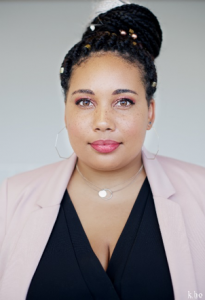
On March 14, we’re pleased to host “Lead, Succeed, and Inspire: Join Justice Minister Jody Wilson-Raybould for an Evening with Changemakers” in recognition of International Women’s Day and the International Day for the Elimination of Racial Discrimination.
Ahead of that event, our panelist Cicely Blain – writer, facilitator, activist, artist, founder, Black Lives Matter Vancouver, and UBC alum – shares their thoughts on activism, community, and creating change. Cicely graduated in 2016 with a degree in Modern European Studies and a minor in Russian language.
Many students at UBC are trying to make their activism more impactful & effective. What activism have you been involved in that brought a productive response? Any tips or insights?
I’ve been involved in activism for as long as I can remember. I used to go on marches with my grandma to stop gentrification in my home town, a suburb of London. It was instilled in me for a long time that some systems are broken and you have to fight to fix them. When I was 15 I became involved in a youth group and we advocated for more educational and leisure opportunities for disadvantaged youth. We won $8 million from the British government.
My passion continued at UBC. The first protest I went to was in my third year when we campaigned against the rise in tuition fees. And to celebrate my 22nd birthday I organized an event in solidarity with students of colour fighting institutional racism. This inspired me to found Black Lives Matter Vancouver when I graduated. I would encourage people who are passionate about change and frustrated with injustice to channel their energy into something positive. Through BLM I’ve been part of creating so many amazing spaces, hosting events for 1000s of people, making people feel seen and celebrated, and making people smile.
What are some lessons you have learned from being a founder of Black Lives Matter Vancouver?
I’ve learnt a lot of lessons but mainly that community is what keeps us going. Sometimes the world seems scary and you feel helpless when thinking about systemic issues but if you focus more on local change and building communities and helping people around you, it’s very impactful and very rewarding.
You’ve recently launched Cicely Blain Consulting. What motivated you to focus on building safe & inclusive work environments?
Being an activist and having my name know around the city, lots of people asked me to do workshops and educate them on being better allies. I’ve always looked for a way that I can make these things my main thing in life while still surviving capitalism. I want to make change in schools, nonprofits and businesses so that everyone feels more included and safe.
UBC Celebrates International Women’s Day
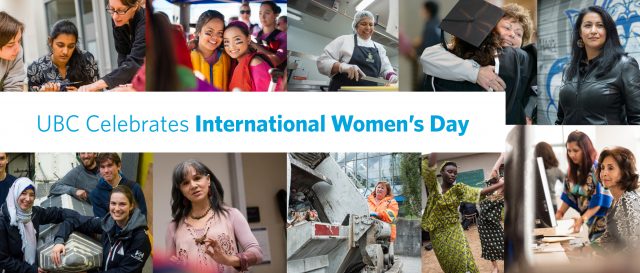
Today we recognize the incredible and diverse women that shape UBC – and our lives and communities.
International Women’s Day
International Women’s Day is an opportunity to celebrate and recognize women – and call for progress. At UBC, we continue our efforts to build a more inclusive community for all.
This year International Women’s Day is aiming to draw attention to the experiences and activism of rural women. Rural women make up almost half of the agricultural work force and are central to global food security. However, they often lack both decent work and social protection, and are more vulnerable to the effects of climate change. This year we encourage you to learn about the work rural women are doing to claim their rights and improve their livelihoods and wellbeing.
Stories from Women at UBC
Women are bringing new perspectives to the skilled trades. Hear from one of UBC’s newest journey-level steamfitters.
Dr. Jennifer Love, Senior Advisor on Women Faculty shares how she creates positive change at UBC.
Events
Looking for ways to engage, learn and celebrate?
Structural Oppression: Male Privilege with Harley Eagle
March 8 @ 10:00 am
NSERC Presents: Initiatives to Advance Equity, Diversity, Inclusion and Research Excellence
March 8 @ 11:00 am
Feminist Time: Remembering the Suffragette and the Work of Suffrage Fiction
March 8 @ 4:00 pm
Luminescence: Chanteuse to the Power of Three
March 8 @ 7:00 pm
YWiB UBC International Women’s Day Banquet
March 8 @ 6:30pm
March 14 @ 6:30 pm