UBC launches inaugural Student Diversity Census 

UBC launches inaugural Student Diversity Census 

New census will provide UBC with important demographic data to better understand the diversity of the student body, identify barriers to inclusion and opportunities to enhance student experiences, and assess progress. 

Advancing equity and anti-racism is one of UBC’s institutional priorities. Core to advancing these commitments are efforts to identify and address systemic barriers and inequities where they exist for historically, persistently or systemically marginalized (HPSM) students. The newly launched Student Diversity Census is an important step to obtaining a more accurate understanding of student diversity and of the barriers to equitable and inclusive access to programs and services.

Launched on September 25, all UBC students are encouraged to complete the confidential and secure census at their earliest convenience – and in advance of the first data analysis which will use the information provided by students up until December 11. The link to complete the census is available in a student’s Canvas inbox.

“Our efforts to improve student access, inclusion, wellness and success for all students are enabled by our ability to collect student diversity and student experience data,” says Ainsley Carry, Vice-President, Students. “This census provides a quick but important way for students to help us refine our programs and services.”

What’s the difference between a census and a survey? 

While surveys tend to rely on a smaller sample of respondents from a community, a census aims to collect information from everyone (aiming to get as close as possible to 100 per cent participation). A census is used to maximize accuracy when the aim is to gather more robust information on sub-groups within a population. 

The census takes between 5 and 10 minutes to complete. Every question has an “I choose not to disclose” option so that students can participate in the census to the fullest extent with which they are comfortable. 

The census, and census questions, have been developed and guided by consultations with students from HPSM groups. Only aggregate-level data will be reported on and no personally identifiable information will be shared. All information is confidential and hosted on a secure UBC platform. 

“This is now UBC’s principal tool to better understand the diversity of our student community, and it’s essential to our ability to identify barriers to inclusion faced by students,” says Arig al Shaibah, Associate Vice-President, Equity and Inclusion.

“While we have qualitative data and a sense of where those opportunities already lie, the census will provide an additional and important dimension to deepen that understanding and better focus our efforts.” 

The census also fills an important gap in the coordination and standardization of student data collection. Until now, Faculties and programs have engaged in separate and varied ways to collect student demographic data. Now, through a more centralized process, Faculties and programs will be able to have access to a more robust data set for their local needs allowing them to better understand how they can support HPSM students. Faculty and staff interested in learning more about accessing or using student demographic data can contact the Student Demographic Data project team

In early 2024, a report on the results of the Student Diversity Census will be shared with the campus community and institutional leadership including the Board of Governors, to inform future decisions and guide institutional EDI efforts.  

Following this initial roll-out, the census will in the future be integrated into Workday Student

Learn more about the Student Diversity Census here.  

Equity in Action: 2025 Year in Review from the AVPEI

By Dr. Arig al Shaibah, Associate Vice-President Equity & Inclusion

As the year draws to a close, this moment of transition offers an opportunity to reflect on the collective effort and endurance that have shaped and sustained our work to advance equity, diversity, and inclusion (EDI) across UBC. 

This season is also a time when many communities pause to reflect and gather to celebrate traditions such as Hanukkah, Christmas, Kwanzaa, Bodhi Day, and Lunar New Year in February. In that spirit of reflection and connection, I want to acknowledge these observances and use this opportunity to express my heartfelt gratitude to our partners across the university for their ongoing commitment to moving EDI forward at UBC.

This work continues in a complex and evolving landscape. Across Canada, conversations about EDI have become more polarized, and in parts of the United States, some initiatives have faced significant challenges. Against this backdrop, it has been inspiring to see communities of students, faculty and staff share ideas and collectively affirm broad commitments to safeguarding human rights and academic freedom to promote a culture of belonging and inclusive excellence.

In this year-in-review, I’m pleased to share highlights of our collective progress and outline some of the priorities that will guide our work in 2026 and beyond.

2025 at a glance

Growing EDI learning and community

Below, you can expand each heading (+) to learn more about this work.

Building an online hub for EDI learning

This year, we continued building an online hub that brings together practical EDI learning resources, and launched three educational booklets, including on human rights obligations, anti-Jewish discrimination, and anti-Arab and anti-Muslim discrimination

Creating spaces for community and connection

Through gatherings such as the EDI Action Network, Employment Equity Advisor Program Capacity-Building Retreats, Conflict Engagement skill-building sessions and the EDI Learning Series, we created more spaces where our students, faculty and staff can connect, share lived experiences and build their EDI practice.

Funding community-led EDI projects

In 2025, the StEAR Enhancement Fund made up to $300,000 available in grants of $500–$10,000 to support student-, faculty- and staff-led projects that advance UBC’s equity and anti-racism priorities. Two of three calls are complete and we are excited to announce the awardees in the new year.


Strengthening accountability through data and shared learning

Deepening understanding of student and employee diversity

We released the 2024 edition of the annual Employment Equity Report and conducted the 2025 employment equity census, with the cumulative response rate to the census now surpassing 90 per cent overall. We also supported the 2025 Student Diversity Census. These efforts enable data-informed conversations and efforts about representation, hiring, promotion and retention, and helps Faculties and portfolios prioritize concrete actions.

Tracking progress under the StEAR Framework

Releasing the Progress Report on the StEAR Framework marked two years since the launch of the StEAR Framework and Roadmap for Change in 2023. In a Q&A reflecting on this progress, I speak to what is working well, where indicators remain challenging to move, and how community feedback is shaping the next phase of our equity and anti-racism work.

Partnering with units to advance EDI on the ground

We know that change happens in units, in departments, in classrooms and offices. This year, we expanded our catalogue of unit and departmental initiatives that advance UBC’s equity and anti-racism priorities. The catalogue offers a shared view of EDI work across our campuses, supporting peer learning among units and helping us tailor supports and track progress over time.


Advancing accessibility across campuses

Advancing accessibility planning

We released a report on UBC’s Accessibility Plan this year. An Action Plan is also being developed to identify what UBC is doing well and where there are opportunities to improve compliance with new standards and to progress institution accessibility aspirations aligned with the university’s equity and inclusive excellence goals. The EIO has hired a strategist and seconded a project manager to support and sustain accessibility planning, implementation and evaluation work.

Additionally, planning is underway for a campus consultation process to engage disabled students, faculty and staff to inform the Action Plan in early 2026.

Launching pilot toolkit to support workplace accessibility

This fall, we launched a Workplace Accessibility & Inclusion Action Research (AIAR) Toolkit pilot to support units in having more meaningful conversations about disability and accessibility in the workplace. It offers practical tools, such as a unit assessment survey and action-planning templates that I hope will help leaders and teams move from one-off accommodations toward more proactive, systemic approaches to inclusion in the workplace.


Progressing Black excellence

Supporting Black community wellbeing and connection

Our office has been working to strengthen the Black Excellence ecosystem at UBC – to bring more intentionality to efforts to support Black student, faculty, and staff inclusion and flourishing. One of the initiatives I have been especially heartened by is the launch of the Black Mental Wellness Collective. Founded and led by students, the collective creates space where Black students can show up as themselves, free of judgement, and build community rooted in care, connection and cultural understanding. With guidance from colleagues in the Equity & Inclusion Office, we were able to provide seed funding and space for the Collective’s welcome event, supporting a community that centres the mental, emotional and academic wellbeing of Black students.  

This past year we also implemented two very well-attended student, faculty and staff networking events – one on each campus. And the university progressed the Black faculty cohort hiring initiative bringing the total number of new scholars hired to thirteen out of a possible twenty-three planned over the life time of the initiative.


Looking ahead to 2026

As we look ahead to 2026, I am mindful that this work is long-term and iterative. The initiatives highlighted in this year-in-review are not endpoints, but building blocks in a broader journey to transform our systems, cultures and relationships. In the coming year, we will continue:

Advancing Black excellence at UBC

Guided by our commitments to the 2020 Scarborough Charter, and building on the work outlined in the Black excellence report, we will deepen our efforts to advance Black excellence across UBC. This includes strengthening pathways for Black students and scholars, addressing structural barriers in recruitment and retention, and supporting relevant programs, research and community spaces in sustained and coordinated ways.

Deepening our understanding of employee and student diversity

We will build on our employment equity and student diversity data to better understand who is represented across our campuses and where inequities persist. This work will help us refine our goals, monitor change over time, and support Faculties and portfolios to align hiring, retention and student success efforts with UBC’s equity commitments.

Engaging community members to inform accessibility planning and action

In consultation with the Accessibility Committee, we will move forward with a campus consultation process to engage disabled students, faculty and staff in building on what we have already heard about accessibility barriers and in co-shaping priorities for how we move forward.

Evaluating and reporting on progress of UBC’s strategic EDI commitment

We will continue to implement the StEAR Roadmap and evaluate our progress on UBC’s strategic equity and anti-racism commitments, using the StEAR Framework to identify where momentum is building and where we need to adjust course. Our focus will remain on sharing meaningful progress updates, and on using what we learn to guide concrete institutional decisions.

Expanding and updating educational resources

We will continue to grow our suite of educational resources on foundational EDI and conflict engagement, while also launching updates to the Hiring Equity course. Together, these offerings are designed to meet people where they are—whether they are search committee members, hiring managers, HR partners or leaders and teams seeking to strengthen their EDI practice—and to make it easier to embed equity into recruitment, navigate difficult conversations, and move beyond compliance toward practices that actively counter bias and open up pathways for equity-deserving candidates.


I want to extend my heartfelt thanks to everyone who has contributed to advancing equity, diversity and inclusion at UBC this year, and in particular to my colleagues in the Equity & Inclusion Office on both campuses for their steadfast work and care. As we head into the holiday closure, I hope you can find time for rest, reflection and connection, and I invite you to stay engaged with the initiatives and resources through our newsletter as we continue this journey together in 2026.

Remembering December 6, 1989

DEC6-website

What happened on December 6th, 1989?

On December 6th, 1989, an armed man entered an Engineering class at l’École Polytechnique de Montréal. After he forced the men to leave, he said he ‘hated feminists’ and began shooting the women students in the class. He continued onto the rest of the school, firing at women on the campus. At the end of his rampage, he had murdered 14 women and committed suicide.

In response to such acts of violence, Canada established December 6th as the National Day of Remembrance & Action on Violence Against Women. It is a remembered of this national tragedy, and provides us with an opportunity to reflect on the nature of gender-based violence across the country.

At UBC, we want to recognize that violence against women is an ongoing reality, influenced not only by sexism, but also by poverty, racial discrimination, colonialism, and other factors. While we remember this tragic event and honor the women who died, we also want to think critically about why we remember this act as a national tragedy, when so many acts of violence against women are not memorialized in this way.

Download Poster with UBC events

Events at UBC Vancouver

14 Not Forgotten Memorial:
Date: Tuesday, November 18
Time: 12:30-1 p.m.
Location: The Wayne and William White Engineering Design Centre Courtyard
____________________________

Panel Discussion: An Examination of December 6th: 25 Years Later
Date: Tuesday, November 25
Time: 12-1:30 p.m.
Location: Simon K. Y. Lee Global
Lounge, Media Room, Building 1, 2205 Lower Mall

Find Tickets at www.eventbrite.com
Share and promote this event: Facebook event page
____________________________

Silk Screening T-shirt Workshop:
Date: Tuesday, November 25
Time: 7-9 p.m.
Location: Place Vanier Residence, Boardroom
____________________________

Candlelight Vigil:
Date: Friday, December 5
Time: 10 a.m.-4 p.m.
Location: SUB Main Concourse
______________________________

Presented by AMS Student Society, Sexual Assault Support Centre and UBC.

Resources and information for women at UBC Vancouver campus: http://students.ubc.ca/campus/diversity/women


Starting a new tradition – Apples for UBC Profs

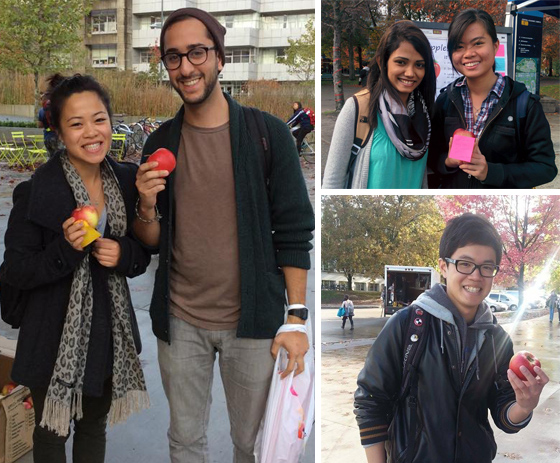
Some cultures have a familiar tradition where students can bring an apple to their teacher as a sign of appreciation. On October 29, student volunteers from Land and Food Systems teamed up with the Equity and Inclusion Office to create a new tradition at the UBC campus – Apples for UBC Profs.

Within a few hours, nearly 500 apples were handed out to students as they headed to class, with the promise they would give the apple to their professor. Several students opted to give the apple anonymously and others wrote a short note to accompany the apple. With two locations, outside the SUB and the UBC bookstore, a broad spectrum of students participated, from Arts to Sciences. The event took place during Celebrate Learning Week.

“Students bring many cultures from around the world to UBC and create a richness of diversity in the classroom. This also creates some challenges around how to show appreciation to instructors across cultures, “said Alden Habacon, Director of Intercultural Understanding Strategy Development who helped initiate the project.  “Some students come from backgrounds where gift giving is commonplace and for others it is not. At UBC we wanted to bring back the tradition as a way for students to show a gesture of appreciation to their profs.”

A quick look at some of the notes written by students showed positive and supportive comments: “For Dr. Bradley! #apples4ubcprofs – thank you!”; “Thank you! Mining is cool” and “Thanks 4 being awesome!”

Are you a prof who received an apple? Tell us about your reaction by email or @EquityUBCV on twitter, or facebook.com/EquityUBCV.

Apples-web-story

The Equity and Inclusion Office thanks the UBC community for its support including the UBC Botanical Garden and Apple Festival volunteers, Alma Mater Society, Campus + Community Planning, UBC Development and Alumni Engagement, UBC Recreation, and UBC bookstore.

Special thanks to Land and Food Systems and Agora Café for providing great volunteers: Carmina, Hussam, Jessica, Katie, Kellyanne, Kristy, Krystal, Min, Samantha, Stephanie and Tori. Additional thanks to the following student societies for promoting this event to their members: Arts Undergrad Society, Commerce Undergrad Society, Geography Student Association, and Kinesiology Undergrad Society.

To see photos from the event visit the Equity and Inclusion Office facebook page: https://www.facebook.com/EquityUBCV


This Halloween – Think before you dress up

Halloween-Respect-560-UBCV
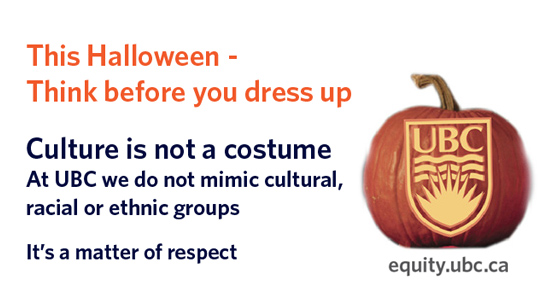
Halloween is around the corner and many students are planning their costumes for on-campus or off-campus parties. It is a good time to remind everyone in the UBC community that culture is not a costume. At UBC we do not mimic cultural, racial or ethnic groups. It’s a matter of respect.

It is important to think before you dress up and be aware of the hurtful racist or sexist stereotypes that are sometimes portrayed in costumes. For whatever reason, this is the one time of year when it is often perceived to be OK to be blatantly and unabashedly racist, and in many cases sexist. Racist and sexist stereotypes aren’t funny, and culture, ethnicity, and race are not costumes.

Everyone can do their part to create a respectful environment at UBC. We encourage you to share the information below widely on social media and with your clubs, fraternities, sororities, residences and classrooms. Best wishes for a safe and respectful Halloween, the Equity and Inclusion Office

Resources and Events

Read this blog!
Hip Vs. Horrible Halloween Outfits by Hannah Barath, Access and Diversity Co-op student.

“Culture is not a costume” resources

Social Media messages

  • This Halloween – Think before you dress up. Culture is not a costume. At #UBC we do not mimic cultural, racial or ethnic groups. http://bit.ly/1rgAMHH
  • Culture is not a costume. This Halloween – think before you dress up. At #UBC we do not mimic cultural, racial or ethnic groups. http://bit.ly/1rgAMHH

Read more

Bubble tea: creating cultural diversity at UBC one cup at a time

bubble_tea-blog-UBCO

Alden Habacon, UBC’s Director of Intercultural Understanding Strategy Development, enjoys a bubble tea with Jenica Frisque, from UBC Okanagan’s Equity and Inclusion Office, second-year arts student Tiffany Huang, and UBC Okanagan’s Lisa Levell.

Story by Patty Wellborn, University Relations, UBC Okanagan

A group of UBC students is using a novel ethnic beverage to bring people together.

Grace Mak, a third-year human kinetics student who moved to Canada from Hong Kong six years ago, can often be seen on campus with a cup of bubble tea in her hands. Mak is the president of UBC Okanagan’s Teaholic club, a group of students who want to share bubble tea with fellow students, faculty, and staff.

teaholics_club-blog2

Grace Mak, right, serves bubble tea during a university event.

“We see a good example of cultural interaction in Vancouver bubble tea shops, so we wanted to promote this special drink of Asian culture to students in Kelowna that come from different backgrounds and places,” says Mak.

Bubble tea is a tea-based modern fusion beverage that originates from Taiwan. Fresh tea is mixed with different flavours and coloured tapioca. The tapioca, flavourless, chewy, gluten-free, and starchy, is known as “pearls” or “boba,” explains Mak. The tea is served cold, and is consumed with a large straw so the tapioca, or bubbles, can float into the mouth.

This week UBC celebrates Diversity and Equity Week and Alden Habacon, UBC’s director of Intercultural Understanding Strategy Development, says the bubble tea club is a wonderful example of students working together to share their culture. Teaholic club executives are from Taiwan, Hong Kong, and China and the students are from a number of faculties and schools including Management, Arts and Sciences.

Habacon says having a culturally diverse campus directly benefits the learning of students, the work experience for faculty and staff, and UBC’s relationships with its communities.

“This commitment to intercultural understanding requires all sorts of good things to happen—like friend-making and trust building across cultures—that ultimately make UBC a more socially sustainable place to learn, live, and work,” says Habacon.  “Places that are as diverse as UBC, or aspire to be, are watching to see how we make this happen. That’s an incredible opportunity. ”

The Teaholic club sells tea at various times across campus and organizes cultural events that are open to all students. During Diversity and Equity Week, they are also sharing bubble tea the Day of Health and the Tea from Around the World event on Friday, October 3.

An acceptance letter 69 years late

Story by Heather Amos, UBC Public Affairs

An 87-year-old Canadian doctor of Japanese ancestry is the first student in a new UBC program on Asian Canadian studies

It’s always disappointing when you don’t get into your university of choice, but Henry Sugiyama’s rejection from the University of British Columbia 69 years ago was particularly painful.

Sugiyama, then a Kamloops high school student, was more than qualified. He’d even won an entrance scholarship to the university based on academic merit. But the year was 1945 and the War Measures Act still forbid Canadians of Japanese ancestry like himself from living on Canada’s West Coast.

“The Second World War ended that summer and I was no longer an ‘enemy of the state.’ There was no real reason why UBC couldn’t take me,” he says.

Now he is getting his chance. The 87-year-old retired Toronto doctor is the first student to be admitted to a new UBC program that aims to tell the oft-neglected stories of Asian Canadians.

Read the complete story at UBC News

Happy Pride: Do you know your Pride Flags?

Thousands of people will fill the streets of Vancouver’s West End on August 3 to view the annual Pride parade. The staff at the Equity and Inclusion Office wish a Happy Pride to all our fellow UBC students, faculty and staff.

For those watching the parade here are some examples of the flags you may see to represent the gender and sexual diversity of the lesbian, gay, bisexual, trans* (transgender, transsexual, trans-identified), two-spirit, queer, questioning, intersex and asexual + (LGBT*TQIA+) communities.

Make UBC a Positive Space for LGBT*TQIA+ communities
Attend a Positive Space workshop and help make UBC community a more inclusive and welcoming place for lesbian, gay, bisexual, trans* (transgender, transsexual, trans-identified), two-spirit, queer, questioning, intersex and asexual (LGBT*TQIA+) communities and individuals on campus. Workshops are held throughout the year at UBC Vancouver and Okanagan campuses.

The famous Gay Pride rainbow flag originally designed in 1978 by Gilbert Baker

The famous Gay Pride rainbow flag originally designed in 1978 by Gilbert Baker

Transgender Pride flag

Trans* Pride flag (Transgender, Trans-identified +)

Bisexual Pride

Bisexual Pride

Straight Pride flag

Some of the flags to represent Straight Pride

Pansexual Pride

Pansexual Pride

Genderqueer Pride

Genderqueer Pride

Polyamorous Pride

Polyamorous Pride

A rainbow "A" against a "straight" background is the Straight Allies Pride flag

A rainbow “A” for “Allies” against a black and white “straight” background is the Straight Allies Pride flag

Equity Enhancement Fund supports 13 projects

EEF-fund-May30
School of Kinesiology students are B.U.I.L.D.ing relationships between people with intellectual disabilities and the UBC community

The 2014 UBC Equity Enhancement Fund results have been announced with thirteen groups receiving funding for new initiatives designed to enhance equity at UBC. Interest was high this year with the Equity and Inclusion office that administers the fund receiving 26 proposals from Vancouver and 10 proposals from the Okanagan.

“We are pleased at the number of high quality applications we received this year,” said Gurdeep Parhar, Acting Associate Vice President, Equity and Inclusion. “The projects chosen are closely aligned with the University’s commitment and responsibilities to enhance equity across campuses and we look forward to seeing the results of these innovative initiatives.”

This year there were a larger number of applications received from the UBC Okanagan and the Equity and Inclusion Office notes the support of Deborah Buszard, Deputy Vice-Chancellor and Principal, Cynthia Mathieson, Provost and Vice-Principal, and Jenica Frisque, Equity and Inclusion Educator in promoting the funding opportunity.

In the recently released Renewing our Commitment to Equity and Diversity report, it was announced that the 2014/15 Equity Enhancement Fund will receive an additional $50k of funding to better support initiatives to enhance student, faculty and staff competencies and experiences at UBC .

Equity Enhancement Fund 2014 recipients for UBC Vancouver

Project name: B.U.I.L.D. club: Building Understanding of Intellectual Disabilities.
Recipients: School of Kinesiology – Rachel Brodeur, Rhiannon Evans, Kimberley Jung and Emily Ryan
Description: The objective of B.U.I.L.D club will promote involvement in the Special Olympics Canada Summer Games (July 8-12, 2014) and increase awareness of intellectual disabilities amongst students, staff and the University community. They will work to build sustainable relationships with intellectual disability organizations and members of the UBC community.

Project name5th Annual F Word Conference.
Recipients: Institute for Gender, Race, Sexuality and Social Justice Undergraduate Students Association (GSJUSA) – Meghan McCabe, Krystal Valentine and Caity Goerke
Description: The F Word Conference is a unique, student-run event that fosters the research of undergraduate students interested in feminist thought, as well as feminist scholarship and activism more broadly. It aims to raise awareness about a range of important issues, including but not limited to indigenous studies, queer theory, fat-positivity, anti-racist work, decolonizing methodologies and their intersections with feminisms, social justice, and sexual assault.

Project NameNEHIYOPASQUAITSIMOWAN POW-WOW (2014)
Recipients: Indigenous Student Association at UBC – Rebecca Doughty and Salia Joseph
Description: In response to the lack of inclusive cultural celebrations at UBC, members from the Indigenous Students Association (InSA) and the First Nations Studies Students Association (FNSSA) will collaborate to host a pow-wow in the fall of 2014. InSA is a student club that encourages and promotes members to engage and learn Indigenous cultural practices while simultaneously building a sense of community through social events.

Project nameKnowing the Land Beneath Our Feet at UBC.
Recipients: First Nations Studies Program – Dr. Daniel Heath Justice, Spencer Lindsay and Sarah Ling
Description: The goal of this project is to facilitate ethical community engagement and make visible the rich Indigenous history of UBC by providing faculty, students, and staff a physical and virtual Indigenous walking tour of the UBC Vancouver campus.

Project nameInspiring a Career in Health Sciences.
Recipients: MD Undergraduate Program, Faculty of Medicine – Ali Majdzadeh and Michael Jew
Description: The objective of this outreach program is to introduce students from low-income families, in grades 8-10, to a variety of health science programs and activities to inspire career choices in Health Sciences.

Project nameWidening the Circle: Indigenous Pedagogies in Teacher Education.
Recipients: Faculty of Education – Jan Hare and Jo-ann Archibald
Description: This project aims to modify and enhance curriculum experiences in the Teacher Education program through the engagement of Indigenous knowledge holders (e.g., Elders and knowledge keepers). These knowledge keepers will mentor faculty/instructors and model for them, as well as the 680 teacher candidates in the program, the practices of Indigenous pedagogies in a range of undergraduate course settings.

Project nameEmerging Aboriginal Scholars Summer Program
Recipients: Department of Mathematics and First Nations House of Learning – Melania Alvarez and Debra Martel
Description: A five week summer internship program where aboriginal high school students will take courses in math, science and English, work with members of the university community, engage in cultural activities and learn about academic and career possibilities at UBC and beyond.

Project nameWhere Are We in the World? Enhancing UBC as a Place for Transformative International Community-Building.
Recipients: St. John’s College (SJC) and Centre for Teaching, Learning and Technology (CTLT) – Professor Henry Yu and Amy Perreault
Description: The project will build upon existing strengths at SJC and CTLT to create processes and resources that can be used to foster community and capacity building, to enhance intercultural dialogue and understanding on campus, and to help create a better sense of belonging and place among international graduate students at UBC through flexible learning experiences.

Equity Enhancement Fund 2014 recipients for UBC Okanagan

Project Nameyr’kstmncutəlz “Around the Circle”
Recipients: UBCO Aboriginal Programs and Services – Sandra Young and Dan Odenback
Description: yr’kstmncutəlz “Around the Circle” provides a tangible approach to incorporating Indigenous culture, practices and teaching into campus operations as a means to support and advance Intercultural understanding at UBC Okanagan’s campus.

Project NameIndigenous Activist Art: Residency Program
Recipients: Faculty of Creative and Critical Studies – Ashok Mathur
Description: The intent of this residency program is to bring together well-established Indigenous artists from across the country to present new work, develop collaborations, and integrate Indigenous methodologies around art and daily process into the fabric of UBC Okanagan and the Kelowna community at large.

Project NameWomen in Engineering at UBC Okanagan
Recipients: School of Engineering – Teija Wakeman and Renee Leboe
Description: The goal of this program is to provide a platform for women to advance their skills required to be successful in their engineering careers.

Project NameBuilding a strong intercultural and inclusive campus community
Recipients: International Programs and Services – Denise Chan, Leah Sanford and Philipp Reichert
Description: The project objectives are to increase intercultural understanding, communication and competencies amongst staff, faculty and off-campus service providers who work directly with international, aboriginal and visible minority students by providing a variety of professional development opportunities.

Project NameAccessABILITY
Recipients: Disability Resource Centre – Gabriel Tobias
Description: The objective is to increase the accessibility of UBC Okanagan’s current fitness facility and to connect the Human Kinetics Department with the Disability Resource Centre and the UBC Okanagan Fitness Facility to connect certified and capable trainers with individuals registered with the Disability Resource Centre.

Renewing our commitment to equity and diversity

UBCresponseTaskForce

Background

In the Fall of 2013 President Toope convened a Task Force on Intersectional Gender-based Violence and Aboriginal Stereotypes in response to chants promoting rape culture and Aboriginal stereotypes that occurred during student-led Commerce Undergraduate Society FROSH activities.

The Task Force produced 14 recommendations that focus on the climate for faculty, staff and students on UBC campuses. The President and the Executive response and action plan: Renewing our commitment to equity and diversity: UBC’s response to the Task Force Recommendations.  This action plan is not only in response to the student-led chants, but builds upon UBC’s current strengths, understandings and competencies relating to equity, diversity and inclusion in the areas of policy, strategic leadership and planning, curriculum and education, and supporting a respectful community.

Read the Task Force Report

The University’s response to the Task Force

The University has now responded with an action plan that renews UBC’s commitment to equity and diversity. The plan incorporates the Task Force recommendations and builds on current initiatives, policies, and practices.

– Read the University’s response to the Task Force and recommendations

The Intercultural Promise – overview video

As promised to UBC Heads and Directors, the working draft of The Intercultural Promise has been put into a 20-minute overview (video above). The Executive Summary and Working Draft of The Intercultural Promise, can be downloaded below:

Intercultural Understanding Exec Summary v1.9.4 – August 2013
Intercultural-Understanding-Strategic-Plan-Working-Draft-1.9.4-Aug-2013

Alden Habacon, Director, Intercultural Understanding Strategy Development has completed the development of the plan, and is currently working on a more final version and the creation of a website where much of the working draft will live. Implementation is already underway in many units.

Info sessions and presentations are being made all across the Vancouver campus. For more information or to arrange a presentation in your unit, please email Anna Wong at anna.wong@ubc.ca

UBC Intercultural Understanding Strategic Plan: The Intercultural Promise
Executive Summary

Prepared by Alden E. Habacon
August 2013

The University’s commitment towards intercultural understanding is a response to a unique opportunity at UBC Vancouver (UBCV) to be a genuinely intercultural learning and work environment, contribute to the human wellbeing of the campus community, and fulfill the University’s social obligation towards intellectual diversity.

The intercultural understanding mid-level strategic plan, The Intercultural Promise,introduces the conceptual framework and working definitions for the University’s overall approach towards intercultural understanding, and outlines the strategic framework and goals specific to UBCV. This includes the framework for engaging faculty, staff, students and alumni around intercultural understanding, related leadership and staff development, interfaith initiatives and measuring progress. The working draft builds upon UBCV’s unique context, its intercultural assets, and outlines an open framework of six strategic goals, developed through an extensive needs assessment and consultative process with staff, students and faculty.

UBCV is already a culturally diverse campus, strategically positioned with many assets. Being a diverse campus is not UBCV’s challenge, nor is it sufficient as a goal. Contrary to common belief, experience and research show that being on a diverse campus and having regular contact with diversity does not necessarily produce intercultural understanding in students, faculty and staff. Rather, intercultural understanding is the product of intent and design.

UBCV’s Intercultural Assets (The Opportunity)

  • Student body and alumni: highly diverse and possess high expectations for intercultural experiences;
  • Promising place: UBCV is located on the traditional, ancestral, and unceded territory of the Musqueam People, surrounded by culturally diverse communities, and situated on and highly connected to the Pacific Rim;
  • Great degree of expertise and experience: much success in internationalization of students, cultural exchange and international programs, and many existing academic, administrative and cultural centres with expertise in intercultural understanding and related fields;
  • Faculties with high levels of commitment and enthusiasm towards intercultural understanding, with a diverse range of world-leading researchers and experts in areas related to intercultural understanding, and teachers who are passionate and experienced in integrating intercultural understanding into the learning experience.

The Conceptual Framework

To make intercultural understanding more concrete, intercultural fluency is being introduced to describe what this strategic plan aims to cultivate in UBC’s students, faculty, staff and alumni. The term “intercultural fluency” is the derivative of two familiar ideas: academic fluency and “cultural fluency”, and describes the development of intercultural awareness and interpersonal capacity in students, faculty, staff and alumni. The overall aim of this mid-level plan is to establish an organisational foundation from which a collective vision for an intercultural campus can emerge.

The Strategic Framework and Goals

This mid-level plan outlines two sets of strategic goals: the first set address the root issues at UBCV around intercultural understanding; the second set of goals identify what is required to normalize and institutionalize intercultural understanding into UBCV. Faculties, departments and units are invited to concentrate on 1 to 2 strategic goals, per set, varying on their needs, assets and constraints, in a staggered sequence.

  1. Foster a culture of dynamic interaction;
  2. Build capacity for courageous conversations;
  3. Establish intercultural understanding
    as classroom content;
  4. Support faculty vision for excellence;
  5. Tighten connections between expertise and experience; and
  6. Leadership and staff development.